The Other Side of Ironman
By: Sister Dirtbag


So most of you read this blog for training tips, race
reports, and funny stories from Dirtbag.
I’m Sister Dirtbag and I did a fun event recently and wanted to share my
experiences with you. If you have
followed along you know that as Sister Dirtbag I am the Official Athletic
Trainer of Team Dirtbag. Dirtbag is a
great employer, he doubles my salary annually….
Anyway, following along with Dirtbag’s training and event
has made me want to be more involved.
I’ll leave the triathlete-ing to him but I have a sports medicine
background, and love these types of events, so I decided to find a way to be
involved. I got on the Ironman website,
and saw there was a 70.3 in Oceanside every year. Sounds perfect. Once volunteer registration opened up I got
on that, and registered for the medical team.
Then I started getting emails from the medical team leader with all
sorts of good information, common injuries we would see, handbooks, directions,
etc etc. I signed up to work both
shifts, because if I’m going to do it, might as well do it good, right?
Oceanside is about 3 hours from my house, so this involved
heading down the night before and crashing with a friend. Check in time was 5am, so I was up at 4,
ready and in the car by 415. I found my
people, got a shirt and a badge, felt important, and headed to the T1
tent. There were already quite the
number of athletes milling about. This
being my first triathlon ever, it was all new to me. All I knew was Dirtbag’s
recaps. Our T1 tent was stationed at the
entrance to T1, which I guess is prime parking for the Pros. Which was awesome. Getting to see all these people that I’m sure
are a big deal in the Tri world doing their morning routines. We were also stationed right next to the
port-a-pottys. Dirtbag has waxed poetic
about the port-a-potty situation at mass events, and I never quite understood
until now. The race directors thought it
would be a good idea to keep these bathrooms “locked” (zip tied) until 6:30am
for whatever reason. Which means the
volunteer bathroom became the everyone bathroom, and the line leading out of T1
tent was something to see. The locks got
“broken” and re-tied probably two or three times.


Back to the medical stuff.
One of the lead physicians was performing a study on core temperature
changes during the swim portion of a triathlon.
She hypothesized that core temps would drop during cold water
swims. This was measured by swallowing
pill-sized ingestible thermometers, taking a baseline reading, marking the athletes
hands for ID, and sending them on their way, to see them again when they were
exiting the water during the swim.
Pretty cool stuff. The water was 62.8 degrees today, much warmer than
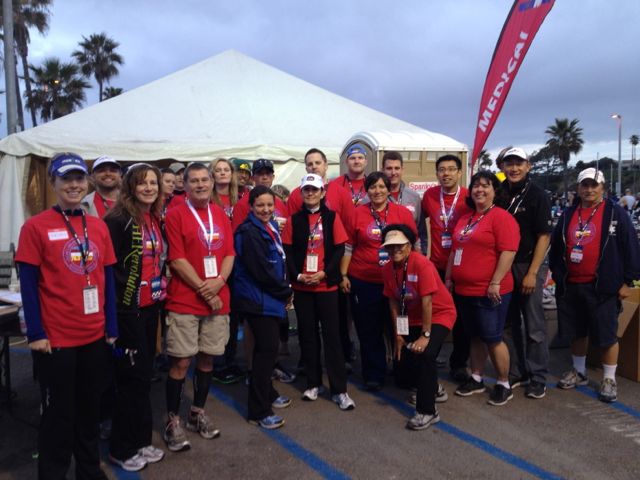
anticipated. We had a meeting, took a
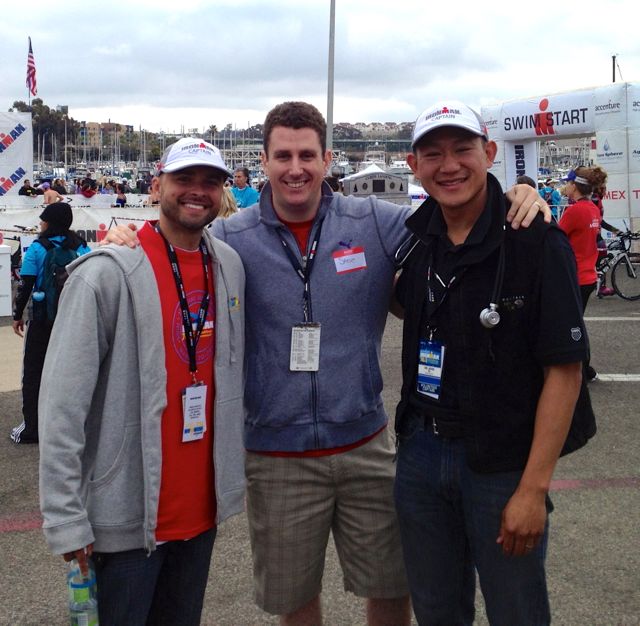
team photo, and got ready to go to work.
By the time we got out of the meeting the pros had already started. I had volunteered to go down to the dock to
help spot the thermometer subjects (also, swimming is my thing, so I wanted to
see this part). The start was at the
boat launch of the harbor (this is the only time of the year swimmers are
allowed in the harbor). So it was a walk in, then swim to a start position out
away from the harbor. It appeared to be
an out and back swim. I situated myself
on the very corner of the dock, so the athletes coming in literally swam around
where I was standing to the boat launch finish.
All access passes do not suck. Not
too long after we got there the pros started coming back in. Andy Potts, the eventual winner (uhh, spoiler
alert), was first out of the water. That
was pretty awesome to see. I snapped a
billion photos during this part of the race. I thought it was pretty
awesome. The end of the swim started my
change in my view of the Ironman races- I thought I was going to see the Pros. Then the end of the swim came. The race director was down on the harbor with
us towards the end, keeping us posted on the cut offs for the swim. We had three or four swimmers in the water
still with 15 minutes left. One of the
coolest things I saw all day was the accumulation of yellow lifeguard rash
guards following behind the last of the swimmers. Towards the end each of the swimmers got an
escort by both the lifeguards on paddleboards and what I am assuming are
Ironman race officials. One on each
side, encouraging, guiding in the right, most efficient direction. Three swimmers left, two, then the last
one. The last swimmer made his was out
of the water to cheers from all of the volunteers, lifeguards, and race
officials. This particular athlete was
competing in his first Ironman race, with a neurological-motor condition that
made it amazing he was competing. He,
unfortunately, was very very affected by the cold water. When we made it back up to the T1 tent he was
trying to get on his bike, but shaking uncontrollably and slightly blue. We moved him to the T1 tent, which had
heaters going full blast. Unfortunately,
he came in at the tail end of time limits, so we had about 5 minutes to work
before he had to be on the bike and out of T1.
Not much you can do with that, but the guy was amazing, warmed up as
fast as he could, and when the race director came in the tent and told him 30
seconds, damned if he didn’t hop up and walk over to his bike, clip in and get
on his way. Amazing.


Oh, and preliminary reports from the thermometers? Temp rises during the swim. When you think
about it doing high-energy activity in a wetsuit it makes sense that you’d get
warmer. Also, when the extremities get cold the body shunts all blood to the
core to keep the vital organs going. So
the core is protected, it is the extremities that are the problem, as I’m sure
most open water swimmers can attest.
It was so odd walking up the dock to T1 and seeing it
completely (save one bike) empty. Everyone just moving on to the next stage of
the race, after that super emotional swim finish. All in an ironday’s work. Off to the main “tent”. It was a trek to the finish line, but we got
to see some of the bikers racing by which was pretty awesome, and by the time
we got to the main tent/finish people were already starting on the run!! Amazing.
I missed one whole leg of the race!
Our friend from the last tent was already in the main medical tent being
treated. Poor guy. I found out this was
his first Ironman, he has friends who were triathletes and they got him into
it. His day was done, but he was in good
spirits about it. Otherwise the Medical
tent was pretty slow at this point, with the race in full swing and athletes
out on the course, away from the finish.
I took this time to wander around, watching the run, scouting out the
finish area. I have to be honest, one of
the coolest perks about this was an all access pass to the race. I could go anywhere and see anything I wanted
to. I headed back to the tent since the
race was still going on.


After a pow-wow with the new volunteers who had joined us
later in the day at this tent, we set about our duties. I helped check people in and out, pulling
their medical history cards as they came in.
We saw a slew of blisters, some people wanting ice, mostly heat
exhausting and exercise-induced collapse though. See, when you’re working hard for 3-4 hours
or more and you suddenly stop, all that blood that has been racing around your
body pools at your feet, and that is what makes you dizzy and lightheaded as
soon as you stop a race. Get you down,
feet up, and in minutes I bet you’ll start to feel a whole lot better. I met another athlete during this time, he
was on his fifth Ironman race, and told me it would be his last for awhile
because his wife was pregnant so priorities would be changing soon. He was so, so grateful for the support we
provided at this event, it was really touching.
I don’t know if that amount of insane exercise makes you weepy or what,
but he was so very thankful, and it made me proud, and humbled to be working
this event. All I did was wake up really
early one morning and take myself and my brain to Oceanside. He prepared for months, years and was
thanking ME?? Uhh, I wouldn’t be needed
if there weren’t people like him willing to do events like these.
The head medical personnel had walkie talkies on them, and
there were EMTs (with Ironman, not with us) out on the course, picking up
people, bringing them in, things like that.
We stated hearing chirping about a guy who had cut his head open, and we
should expect him in soon. Sounds good,
and interesting. Us medical people love
interesting (read: bloody) things like this.
We waited, and waited, and eventually kinda forgot about him, figuring
things just worked themselves out. Then
later on, much much later, a guy comes walking into medical tent under his own
power, with a shirt that used to be white and is now fully red, and a bandage
around his head. Turns out he fell
during mile ONE of the run, cut his head open, and was determined to
finish. Race officials made him stop for
about 45 minutes to try and stop the bleeding (much to his dismay about his
finish time). But he had a medical
condition which made the bleeding nearly impossible to stop. He signed the waiver they wanted him to and
continued chugging along. 12 miles later here he was in our tent, a
finisher. I can’t imagine the talking to
his wife gave him later. She bought him
a new shirt to go home in though. He
said he was going to frame this one with his finisher medal, forget that
washing business! We had our first
stitches of Ironman Oceanside.


Things were slowing down in the medical tent after that
excitement, people were finishing, heading home, but there were still plenty of
people out on the course. I headed out
to the finish line. That, ladies and
gents, are where the true inspiring stories of Ironman are. Hours after the pros had finished and well
after the elite amateurs. Over half the field were first-timers. I saw a husband and wife, the husband had
obviously done this before and finished well long ago, he was standing at the
finish line when his wife crossed, looking like she had done many more
enjoyable things in her time. The
emotion on his face when she crossed that finish was intense, the joy he felt
that his wife had finished her first Ironman, the hug he gave her when she
reached him…several of us were wiping away tears. Let me tell you, if you don’t work the medical
tent, work the finish line, that is where the best stories are. Where the Tri clubs wait and cheer in their
own, where people that you would see on the street and think they didn’t know
what a bicycle was show you what they are made of and become finishers. From the guy in his Tri suit and fancy watch
to the guy in gym shorts and a tank top.
Both finishers. I stayed there
until the very end, 8 hours after the last wave of swimmers started. 9.5 hours maximum course time. As the cut off was coming, I saw a wave of
teal coming down the track. The
volunteers from the run course had gathered behind the last runner before cut
off and were cheering her on, a tidal wave of support carrying her in. I don’t know what the cheers were like for
the first finishers, but I bet they weren’t the decibel that the volunteers
made for the last. It was incredible.
After treating the last few cases of dizziness, it was time
to pack up and head home. What a
rewarding day. The lesson I
learned? It doesn’t matter first or
last, it matters that you finished. Not
even that, it matters that you did the work, got out of bed that morning, and
were there when the whistle blew. That
makes you Ironman. And I thank each and
every one of them for allowing me to be a part of their journey, allowing me to
support them in their goals. I can’t
wait to do it again.